
Industry Insight
The Packaging Bottleneck: Why Manual Bagging Is Holding Your Firewood Operation Back
The wood is cut, split and dried. Then it waits for a bag. For most producers, that wait is the real ceiling on the season.
83% of the time from stump to sale is spent on packaging — not splitting, not drying, not hauling.
Let that sink in for a moment. The wood is cut. It is split. It is dried. And then it sits, waiting to be put in a bag, while the clock runs on your season. For most producers who have not automated their packaging line, that wait is built on the same foundation it has always been: a person, a stand, and a bag.
It works. But the question worth asking heading into 2027 is whether “it works” is still a sufficient answer for a growing firewood operation.

The Real Cost
What manual bagging actually costs you
Manual bagging is not inherently a bad system. At low volumes — a few cords a weekend for a local customer base — it is practical and capital-efficient. The problem is not the method. The problem is what happens when you try to scale it.
A manual bagger requires the same motion, repeated hundreds of times a shift: position the stand, hold the bag open, load piece by piece, pull the filled bag, tie or seal it, set it aside, start over. Each step takes time. That time does not compress under pressure. When demand doubles, the manual line does not run faster — it runs longer. You add shifts, add staff, or add bagging stations. Each option adds cost, coordination complexity, and a ceiling you will hit again.
There is also a category of cost that does not show up directly on the labour line but is just as real: the cost of variability. A manual bagging crew is subject to fatigue, callouts, and turnover. A trained bagger is worth something. That value is fragile. The day your best bagger does not show up is not an abstraction — it is a production hit on one of the best sales days of the season.
For operations that have hit this ceiling, the bagging line has stopped being a task and become a constraint. It is the rate-limiter on the entire chain — not the wood supply, not customer demand, not your split capacity. The wood is there. The orders are there. The bags are the problem.
Continuous Production
What changes with the MULTIPAK
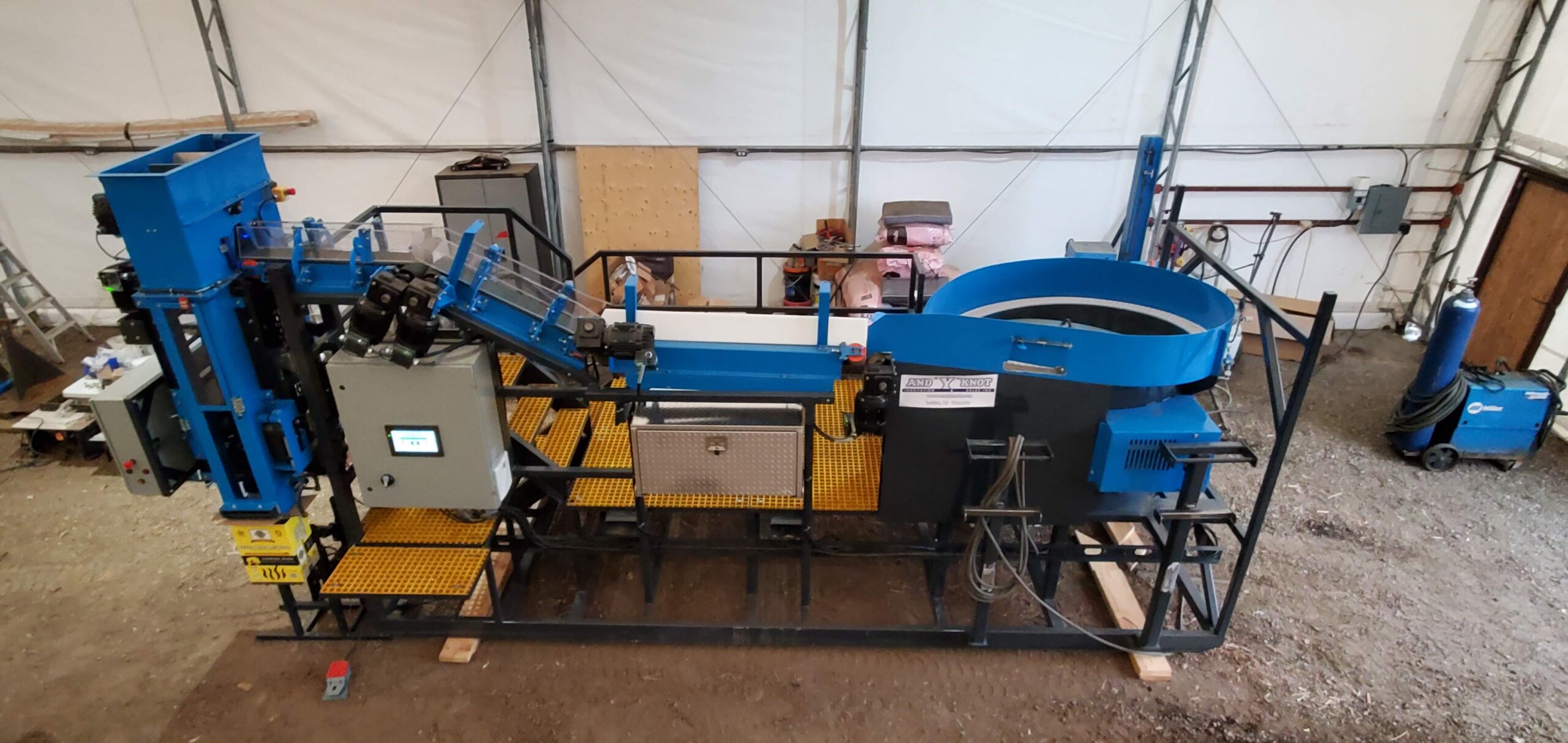
The MULTIPAK Firewood Packaging System from AND “Y” KNOT replaces the stop-and-start rhythm of manual bagging with a continuous production process. The system runs with two operators and produces 3 to 4 bags per minute* — consistently, repeatably, without fatigue degradation over an eight-hour shift.
The machine features dual bagging heads that maintain continuous fill-and-seal output. A 60-inch turntable aligns incoming wood for consistent entry into the bagging heads, eliminating the manual fussing and repositioning that eats time in a manual operation. The result is a production line that behaves like production equipment: predictable input, predictable output, scalable volume.
*Bag speed varies with bag size and capacity.
Two operators. That is all. The headcount is fixed regardless of how hard you push the volume. That is a fundamentally different cost structure than a manual operation that grows headcount in proportion to throughput.

The Ceiling Conversation
Every operation has a throughput ceiling. What is yours made of?
For producers packaging manually, that ceiling is usually the bagging line — not the wood, not the market, not the split capacity. Identifying the real bottleneck is the starting point for making a rational capital decision.
It moves the ceiling, not the needle
The MULTIPAK is not a machine that makes your operation marginally more efficient. Producers who have installed the system are not running the same operation a little faster. They are running a structurally different operation — one where the packaging step scales with demand rather than constraining it.
Gains in the slowest step compound
If 83% of your time is in packaging, improving the packaging step has leverage over the entire chain. A 20% improvement in the slowest step of your process is not a marginal gain. It is compounding.
Lead times are real
Producers planning for 2027 are placing orders now, not in the spring. When a purchase is confirmed, an AND “Y” KNOT representative is on-site at pickup and at startup.
Equipment Details
Getting started
See It Running
Ready to see the MULTIPAK running? Book an on-site demo.
Manual bagging is not broken. But for producers whose real bottleneck is the bagging line, the conversation about automation is not about the future. It is already about today.
